Agents can now write working code in minutes, so why does delivery still feel slow? We put that question to four of the engineers and consultants who build production AI systems at WeBuild-AI, and they did not all agree on the answer.
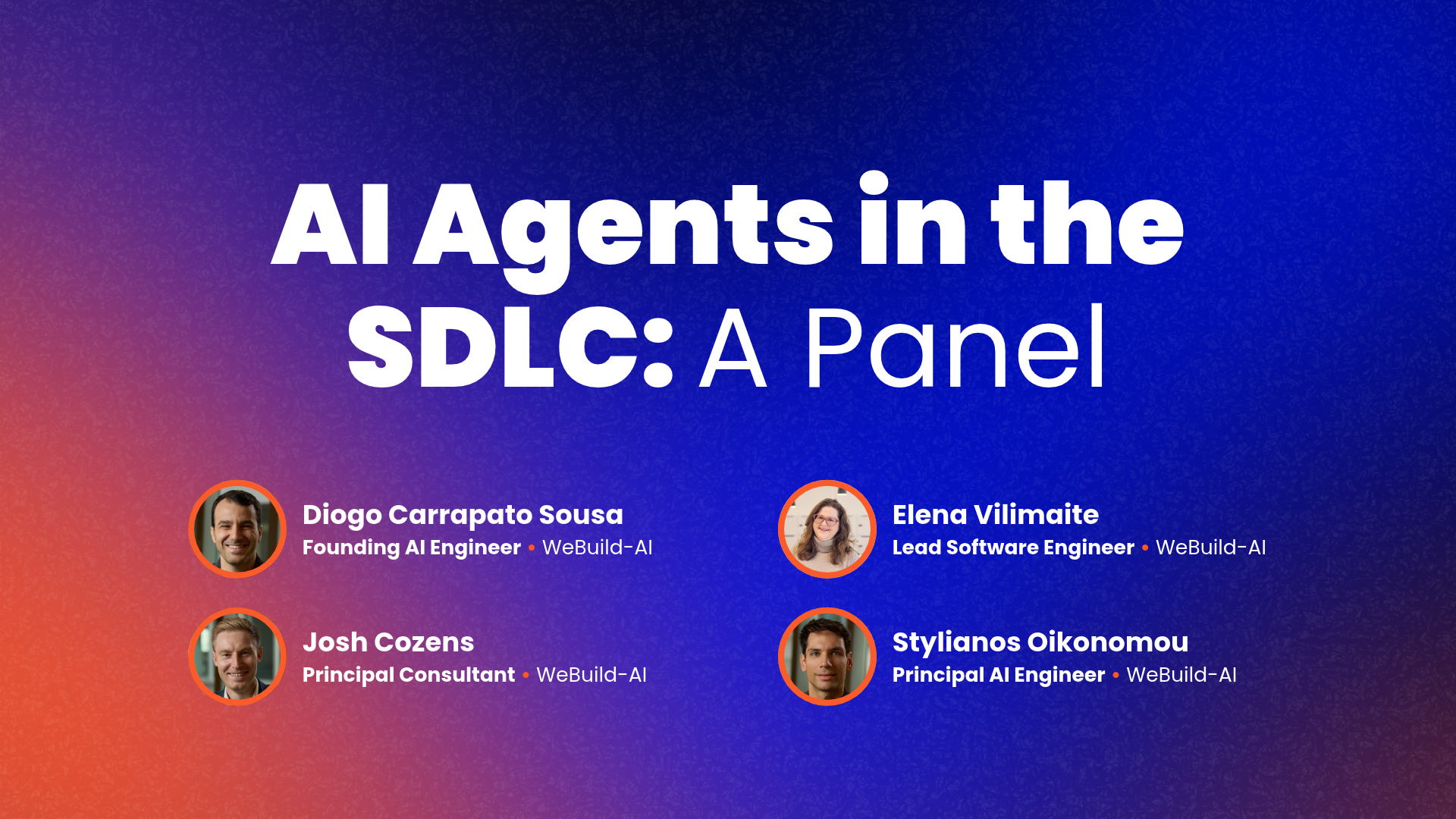
The panel was Diogo Carrapato Sousa (Founding AI Engineer), Stylianos Oikonomou (Principal AI Engineer), Elena Vilimaite (Lead Software Engineer) and Josh Cozens (Principal Consultant). The session was hosted by Cat Snell, Marketing Lead at WeBuild-AI. The full conversation is below.
Key Takeaways
Generating code has become cheap, but engineering judgement has not. The panel agreed that the hard questions now sit around the build, in understanding the problem, designing the system and proving the output is correct.
In regulated work, most of the effort now goes into security and architecture sign-off. Josh described this as the part of the iceberg below the waterline, because it needs input from people outside the project and can take the majority of the time.
Nobody on the panel reads every line of agent-written code, and everyone thinks the author is still responsible for the code they ship. Engineers must be able to explain what they submit before asking a colleague to review it.
Agent reviewers are useful only when they are configured with an organisation's own standards. Left generic, they produce bland reviews, and two models can share the same blind spot.
The panel's advice to CTOs was practical: set clear limits on what agents may decide, keep a verification layer for growing code volume, and agree a shared standards repository that people and agents both work from.
Watch The Session
Is code really no longer the bottleneck?
When did you first notice that the constraint had moved from coding to reviewing?
Diogo: I remember when GPT-3 came out and everyone was trying to use it for code, and honestly it was rubbish. Plenty of the models after it were too. 2025 was the first time I found myself trusting some of the code, and even then I was suspicious of it. Now everything has changed so fast that either you know how to use these tools or you are behind the curve.
Stylianos: I noticed it while delivering enterprise AI workflows. Modern coding agents produce a first implementation extremely fast, but then you reach the harder questions. Does this actually solve the business problem? Is the architecture appropriate? What happens when something fails? How do we know the outputs are correct? With generative AI systems in particular, a working demonstration tells you very little about how reliably the system will perform across different inputs. For me, the bottleneck has shifted towards understanding the problem, designing the system properly and validating it afterwards.
Josh: I don't cut code myself. My job is working out what the product should be and making sure it gets built the right way. We have internal channels that flag when pull requests are submitted, and I often see something I spoke about at stand-up in the morning arrive as a pull request by the afternoon. Then it can take a day or two to be confirmed, for exactly the reasons Stylianos mentioned. Is it airtight? Does it solve the problem? For clients in regulated industries, does it pass the right security checks, and can it be maintained? We need to bring those questions forward into the design, so that by the time we reach the pull request we have covered them and the reviewer is sharing the cognitive load rather than being handed it. For clients, the challenge is making sure they are clear on what we built, how and why, because keeping track of a high volume of changes is genuinely difficult.
Elena: For me the realisation came in early January 2026. I picked up a personal project I had been starting and dropping for about five years, opened Cursor and told the agent to rewrite an API from Ruby into TypeScript. It took about seven minutes, and when I looked at the output, it was sound. It was as good as I would have written it, and it would have taken me a couple of days. So the work has moved to double and triple checking that everything is correct. When I work with agents I give them very specific instructions. I make a rough plan of how I would do it by hand and ask the agents to implement small pieces of it, so I still feel in control of the implementation.
Is planning now the main part of the job, and what else has changed in how you work?
Diogo: Yes. Most of the time now goes into planning, so that you nail the requirements and acceptance criteria and prepare the agents to do a good job. You have to tell the agent exactly what to do and what not to do, and be strict with the rules rather than letting it go rogue. Otherwise the output is still bad and you spend even more time reviewing it.
Stylianos: There is an important distinction between code generation and engineering. An agent can generate hundreds of lines of code quickly, but if the architecture is wrong or it adds unnecessary dependencies and complexity, that speed creates more work later. We still need engineers who understand the system well enough to recognise those problems. I wouldn't say writing code is never a bottleneck, but generating code has become significantly cheaper, while engineering judgement remains as difficult as it always was.
Where delivery waits now
If more work goes into planning upfront, how is that different from agile or waterfall?
Elena: I really don't like it when people say the AI software development lifecycle feels more like waterfall. If it feels like that, I think you are doing it the wrong way. You can have a rough idea of where your app is going and its core features, but you should not write a spec and then say "agent, generate my app". You will get something that looks visually quite pretty but fundamentally doesn't work and has an over-convoluted architecture. If you break the idea down by feature and build the most important one first, then build on top of it, it is still agile. You still plan a lot upfront, but the blast radius of the generated code is much smaller, so you can stop and reassess. You just have to rein yourself in and not get carried away with what AI can do for you.
Diogo: I agree. The delivery cycle is much shorter and much more iterative, in an agile style, with testing, iterating, reviewing and improving happening much faster, always on the right foundation of specifications. At this speed, automated tests become even more important. Agents are still not great at writing them, because they go for the short happy path rather than the complex parts of the application, and that still needs a lot of input and vision from the developer.
Stylianos: I don't think the fundamental principles of software engineering have changed. We still need to understand the requirements, design good architectures and test our implementations. What has changed is how quickly we can implement solutions, which means we can spend more time on understanding the problem and thinking through the architecture. I see that as an opportunity to do better engineering. In practice it means a more iterative, specification-driven approach. We define the expected behaviour and constraints, think through the architecture ourselves, use AI to challenge our ideas and speed up implementation, and then keep validating and refining. Where I do see new bottlenecks is in the processes around implementation, because AI can generate changes much faster than teams can review, integrate and validate them.
Clients are often surprised by how fast AI development is, and human reviews and advisory boards then become the delay. Is that delay necessary, and how will it change?
Josh: We can now go from an idea to something that might work very quickly, which is brilliant, because users are brought on the journey and should be bought in. But if you want something enterprise-grade, the front end moves a lot faster than the back end, by which I mean the infrastructure and security that wrap around it. Anything used by hundreds or thousands of people that handles valuable or confidential data has a larger risk profile. You can iterate through the requirements quickly, but satisfying an architecture advisory board and meeting 20 or 30 security requirements is where the bulk of the effort now goes. People don't appreciate that, because it needs input from people across the organisation who aren't attached to the project and aren't as bought in. Once that sign-off is in place, you can run training, sessions and hackathons and involve users very quickly. You can make a demo in half an hour. The real slowdown is making sure the system is truly secure, can handle strictly confidential data, and can be recovered quickly if something goes wrong. That is the part of the iceberg under the water, and it is where we spend most of our effort.
Is that essential for clients?
Josh: I think every client should have it. The frontier labs want your data, and your most valuable data should not be able to escape your ecosystem, so the protection around it matters, and in a regulated industry even more so. If you lose that data, you have given away a key part of your IP.
If a sprint board only tracks estimates of the work, what would you track instead (and are sprint boards still necessary)?
Elena: I don't think the numbers on the board should track estimates. They should track the complexity of the work, and that shouldn't change whether you do it by hand or an agent does it for you. A large part of the work is still understanding what needs to change and where.
Stylianos: I wouldn't necessarily get rid of sprint boards. They are still useful for coordinating work and seeing what the team is doing. But with AI-assisted development, we need to pay much more attention to the flow of engineering work than to estimates or the number of tasks completed. If AI helps us implement something in a couple of hours but the pull request waits three days for review, that is the real bottleneck and that is what we should measure. The point isn't to replace one tracking tool with another, but to have visibility of the whole engineering process so we can find the real bottlenecks and fix them.
Josh: Story points created the wrong incentive. You run a sprint and set a sprint goal, and the value is whether you achieve that goal in the time frame. People moved to story points because they like KPIs, so what gets measured is activity rather than outcome or value.
Who checks the agent’s work?
Should a human read every line of agent-written code?
Diogo: That's a hot topic in our team, and I bet in every team doing this work. My view is no, a human should not read every line an agent creates, but to get there you need certain controls and capabilities. That doesn't mean a human isn't accountable for every line an agent pushes. The human still needs to understand deeply what the agent generated and not approve it blindly, whether to go faster or because they believe the plan was so good the agent can't get it wrong. You are still accountable for what is in your pull requests.
Who owns the review?
Diogo: The first review is by the pull request owner. You review your agent's code first, and then, as with any pull request, someone else gives it another pair of eyes. It doesn't matter whether they are more senior or more junior.
Stylianos: The engineer remains responsible for the code, whether they wrote it themselves or with AI. Reading every line and establishing that the system works correctly aren't the same thing. We can automate many useful checks through tests and type checking, and AI reviewers can help find potential problems, but none of these tools is an excuse for developers not to understand what they are submitting. If an agent generates a large implementation, it is still my responsibility to understand it, test it and explain why the design makes sense before I ask anyone else to review it. Otherwise we are simply using AI to transfer engineering work onto our colleagues, and that is what makes pull request reviews take so long.
Elena: When I look at a pull request, I identify the core functionality and check whether it makes sense. I definitely don't read every line. I check the comments make sense too, because recently agents have been going crazy with comments everywhere. Then I use my own agent to interrogate the pull request more deeply and ask it questions about the work. For very large pull requests, I get the author on a call to explain what it does, where they think the issues might be and which parts they want me to look at. That way the accountability stays with the author, and as the reviewer I know where my attention is most needed.
Are agent reviewers valuable, and where should they sit in the process?
Elena: They are useful if you set them up correctly. Recently I overhauled the pull request reviewers on WeBuild-AI's repositories and gave them our coding standards. Since then, the quality of the automatic reviews has improved significantly. They check for the things we have agreed matter to us as an engineering community, and they have found bugs and inefficiencies. If you don't configure them and tell them what to look for, they do a generic, bland job.
Diogo: I agree that they are very useful when set up correctly. When they aren't, they cost time and money. One downside is that the person who generated the code can relax, because they know an automatic review will catch bugs and explain the code. That can take some responsibility away from the author, and we need to keep control of that.
Stylianos: If one AI reviews code written by another AI without any human involvement, the two models can make the same mistakes. They can misunderstand the same requirements, rely on the same incorrect information or overlook the same things. One agent generating code and another approving it doesn't tell us much about whether the implementation is correct. An agent can meaningfully assist with review, but it can't replace the human element.
How do you explain agent reviewers to clients, and how much visibility do they get?
Josh: It depends on the client. The more technical ones ask more questions. I use the analogy of an expense policy. You wouldn't get a CFO to approve a coffee, because the risk and spend are low, but for a contract worth hundreds of thousands or millions you would do proper due diligence. It isn't directly the same thing, but where the risk is higher or big things are more likely to break, you bring more expertise to the review. I've also tried to learn French three times, and whenever I stop practising I forget the basics. I don't spend much time coding, so this may not be entirely fair, but I think engineers need to keep practising, especially on complex work. What clients see is that our engineers want to stay close to the code, because they care about ownership and craftsmanship. That is what we are known for and what we want to protect. We use agents to support the work, but never for anything we wouldn't be content to ship.
What does setting up an agent reviewer properly involve?
Elena: My non-negotiables are no repetition, checking for contradictions, making sure tests are high value rather than written just for coverage, and dead code detection, so nothing unused is left in the implementation. Those are the basics. You can then make them more specific for each language, use case or organisation.
Diogo: For me, the reviewer needs to know the whole workspace it is reviewing and have specifications for that particular application, so it can focus on what matters there. Security always applies across the board.
What agents know, and who owns it
When an agent needs to know your standards, architecture decisions or business rules, where does it find them, and who keeps them up to date?
Elena: It depends on how the project is set up, but I like to put as much of the standards as possible in one central place. We've done that for ourselves as an organisation and on client engagements. Most clients already have their own standards, usually in GitHub because that's where engineers like to read things, and if not, in Confluence. You start by pointing your agent at your programming standards and telling it that this is how it will work. For business logic, I store it where it makes sense. If a microservice only processes payments, the payment business logic goes in its CLAUDE.md or AGENTS.md file or its README. In a monolith that does many things, each module gets its own README describing the business logic that unit is responsible for.
Many businesses don't write good specifications. What would you advise a client to do so that we have a good spec to work from?
Josh: There is usually a disconnect between the strategy set at the top and how it is carried out at the bottom. Our job is to work with the momentum of the organisation while relieving the pain at the bottom, so you need input from both levels. That can be captured in a conversation like this one and turned into an output with AI tools. You want a document that sets out the goals, the value behind them, who will benefit, which processes are involved, and what inputs and data you need. A great vision that isn't practical, feasible or viable can't be delivered, so be very clear on what you want to achieve and why. Then hold a follow-up session with potential users. We like to bring prototypes or mock-ups built with AI tools and ask whether they work. People will tell you what they love and what they don't understand. You can walk through the actual flow with synthetic data and spot edge cases very early. All of that feeds into the document, and you can apply MoSCoW prioritisation against your deadline, budget and constraints. That way you release something of value that users care about and are bought into, and the C-suite can tell the board which strategic goal it supports.
What is the worst thing you have seen an agent do because it was missing context?
Josh: In the early days, when I tried building the UI for a customer and partner relationship manager, the agent assumed we were just rebuilding Salesforce, because I hadn't specified what the system was meant to achieve. In my personal life too, I'm training for a big race next year and asked it to look at my previous races. It gave me a plan aiming at the end of August, when it was already 15 October. I thought it had six weeks of information and it didn't, so it planned for something seven weeks in the past. I'm sure the same thing happens in codebases.
Stylianos: One common pattern is that agents fix the specific case rather than the general problem. If your solution fails on one example and you ask the agent to fix it, it will fix that example without the critical thinking needed for a solution that generalises. Another is architecture. When you let an agent make architectural decisions, most of the time they are wrong and you end up redoing the work. If it is running unattended, it may have generated thousands of lines of code that all end up in the bin.
Elena: I've had agents invent APIs that don't exist or have been deprecated. I've had agents ignore the existing front-end components and roll out their own component library, because why not. The one I want everyone to watch for, especially if you aren't strong on infrastructure, is when the agent hits a permissions issue and suggests giving the role administrator access. "Trust me, it will fix everything." It will fix the permissions issue, but it is not safe, and you should always follow the principle of least privilege.
Diogo: After a few days working on an application front-end, I watched the agent change the entire colour palette for no reason and with no instruction. I just thought, why? It did look cool, though.
What engineers do now
What do engineers actually do now?
Diogo: Engineering is more than typing code. It is the thinking and the reasoning behind what gets deployed, and I still do a lot of that. I may not write much code myself these days, because an agent does it, but I still need to understand and design the solution.
Elena: Engineers used to have to work their way up to lead a team. Now anyone with a Claude Code subscription and a dream can lead their own team of agents, so we are still doing engineering, just at a higher level. You don't need to wait for five promotions before someone puts you in charge. You think about solutions and architecture, hope the agents you're responsible for don't mess up, and supervise them the way you might once have supervised junior engineers.
Stylianos: For me, engineering was always about understanding problems, designing systems, reasoning about trade-offs and validating solutions. Programming is the tool we use to implement them. AI makes implementation faster, but it doesn't solve the underlying engineering problem. Someone still needs to understand the architecture, how the components interact, what can fail and whether the design is appropriate.
How do we justify a consultancy like WeBuild-AI when a client could log on with a Claude subscription and a dream and do it themselves?
Josh: First, you need to understand the limits and benefits of using agents in development. I have a Claude subscription and a dream too, and I still haven't released anything after a year, because I don't know how to take a fun idea to something hundreds of people can use, test and give feedback on, then keep improving it as the market moves. Second, think about what happened when CAD became available to mechanical and chemical engineers. They stopped spending so long drawing on paper and could mock things up, change them, make mistakes, experiment more and design more complex parts. Our engineers are very high calibre, and giving them more time to think about what makes a system enterprise-grade and reusable across an organisation pays dividends, because work that used to take three to six months can be done in a fraction of the time and cost. With a consultancy like ours, that focus is the whole point. Inside an enterprise there is BAU work, support and ad hoc requests. We can give our engineers time to sit and think. They are far better with four uninterrupted hours than eight half-hours, which is what they usually get in large organisations. That gives them room to make each pull request properly solid, and because we share what we learn internally, it compounds each time.
What advice would you give a junior engineer about the skills they need today, and how is that different from when you started?
Diogo: Use these tools not just to be faster but to understand what is being built. You can use an agent as a tutor to help you understand the architecture, the principles and the code itself. Use it the right way, rather than turning up with 119,000 lines of code and asking someone to approve it.
Stylianos: If a junior engineer immediately asks an AI to implement a solution, they risk skipping the reasoning that builds the skills needed for real engineering. This is something I focus on in mentoring, and it applies to how we train engineers generally. I want engineers to understand the codebase, how the architecture works, how components communicate and why certain design decisions were made. We spend time discussing pull requests, alternative approaches and their consequences. AI can be a learning tool in that process, but we can't automate our way out of the reasoning or out of building a deep understanding of the systems.
Elena: Read The Pragmatic Programmer and Clean Code, and build your first “Hello World” app without AI. Know what good code looks like and what you are going to build. Experiment without AI so you understand what works and what doesn't, and learn not to trust it. Then you'll be fine.
Josh: As you spend less time writing code, the real value is being able to explain what you've built to someone who doesn't understand it, including what it does and why it works the way it does. Be open to challenging feedback too. When you're new, there are unknown unknowns. You need to be sceptical of Claude, and your colleagues should be sceptical of you. Embrace that, because it's the only way to get better.
What should a CTO change on Monday?
If you could tell every CTO one thing to change, what would it be?
Stylianos: Be cautious about delegating consequential decisions to AI systems. There is a difference between an AI carrying out well-defined tasks and giving it the authority to decide what should happen in an important business process. AI systems are very capable, but they make mistakes, misunderstand things and behave unexpectedly, so we need explicit limits. For me, the objective isn't maximum autonomy. It is building systems that do useful work reliably, while understanding their limitations and staying in control of the consequences.
Diogo: Don't trust it blindly, and ask your team one question. If the amount of code going into production doubles by Tuesday, will you still understand it and be able to follow the whole project? If the answer is no, you need a verification layer and some controls, because you shouldn't be able to put that much code into production without understanding it.
Elena: Set up a shared standards repository that all your engineers agree to and support. That way, your people and your agents will both write higher-quality code.
Josh: Strategies no longer have to live in a PowerPoint or a PDF. Work towards a live AI, data or wider business strategy that what you are developing stays in step with, holding the key logic of your business as shared context so AI doesn't make the assumptions we've talked about. That might mean a knowledge graph, or a well-organised SharePoint folder and an integration layer. What separates generic AI output from something of value that grows is having that context embedded, so there is no gap between the strategy you set in June and what you build in December.