
AI-Ready Data & Infrastructure
Build AI-ready data platforms and ML infrastructure that enable your teams to train, deploy and monitor AI models reliably at enterprise scale.
We build AI strategies aligned to your goals, through production-grade AI solutions, enterprise-ready compliance frameworks, custom tooling and our highly skilled team.

Our Services
We build scalable, enterprise-ready data and AI infrastructure using our unique delivery methodology.
Bringing decades of data engineering and ML experience, we quickly identify where your foundations need strengthening and build platforms that make AI possible at scale.
We offer:
-
Whether you're starting from scratch or modernising a legacy stack, we design and build the data platforms your AI ambitions require - scalable, secure and aligned to how your business actually operates.
-
From model training environments to deployment pipelines and monitoring, we build the MLOps infrastructure that takes AI from prototype to production and keeps it running reliably.
-
We architect and configure cloud and multi-cloud environments across AWS, Azure, and beyond, optimised for AI workloads, cost efficiency and enterprise-grade security.

Our Customers
Our Approach
Most AI projects fail because the data underneath it is incomplete, inaccessible, or ungoverned. We've seen it across multiple industries and it's where we start every engagement.
That means scalable data platforms, production-ready ML infrastructure, and cloud environments built for how enterprise AI actually runs, not how it looks in a demo.
Our Latest Insights
We tested sensitive data detection tools Amazon Macie, Microsoft Purview and three open source tools on 18,049 documents to see how much sensitive data automated data classification really finds. Read for our recommendations and what a layered approach costs to run.
In this post we explore why open source models have crossed the threshold for everyday enterprise use, why Anthropic's decision to open source its Agent Skills framework is a bigger deal than it might first appear, and why the organisations best placed to move quickly with AI are those thinking carefully about where their data lives and which model is appropriate for which task.
In an earlier companion piece we shared that agentic commerce has arrived, that buyers and their agents are increasingly beginning their journeys inside AI assistants, and that the answer an assistant returns is becoming the new shelf.
At an executive partner dinner a little while ago, the conversation drifted, as these conversations invariably now do, towards the question of what everyone is really spending on artificial intelligence. One of the firms around the table offered a figure that gave the rest of us pause.
Ask most boards what AI sovereignty means and you will get one of two answers. Either it is a UK region on a hyperscaler, or it is a box in a private data centre. Both answers share the same flaw: they treat sovereignty as a place. Pick the right location, the thinking goes, and the problem is solved.

Discover which three AI workflows can have the most transformational value for PE due diligence teams, based on our industry experience with real customers and in-house AI expertise.

The open model shift is accelerating, and three moves in the last fortnight show exactly where this is heading. Stop paying someone else's margin to think for you and adopt a multi-model strategy.

Most enterprises are deploying AI faster than they can govern it and regulators are taking notice. This article introduces 10 governance domains that form a practical framework for enterprise AI deployment, covering data protection, sovereignty, regulatory compliance, security, content safety and more, backed by peer-reviewed data and with additional guidance aligned to the EU AI Act and UK regulatory landscape.

Download WeBuild-AI's technical whitepaper covering the 10 governance domains every enterprise must address before deploying AI, aligned to the EU AI Act and UK regulatory landscape.
Highly-regulated industries require data relationships, provenance and context, provided through context graphs that supplement RAG, vector databases and MCP.

Build collaborative and flexible AI governance frameworks that enable rapid innovation, production and delivery, and ensure your AI plans are on-time, on-budget and compliant in 2026.
Read this briefing document for essential insights into how AI will reshape work, skills and competitive advantages in enterprises by 2030.
![Accelerate AI deployment while maintaining compliance through 2026 [Webinar]](https://images.squarespace-cdn.com/content/v1/67ffe031b1ec5e458d56ffe2/1764069307195-S4RKZ5B8G8VQ3NXNND1K/balancing-governance-with-innovation-in-ai-a-strategic-framework-for-scaling-ai-in-regulated-industries.jpg)
Enterprise manufacturing business DS Smith and AWS share their secrets to AI governance, innovation and compliance success, through AWS Bedrock foundation and AI Transformation Consulting from WeBuild-AI.

Evaluate your organisation's AI governance readiness across UK, EU, and US jurisdictions.

Moving from AI theory into AI operations leaves many leaders behind from a regulation and compliance perspective. Here’s what you need to know for 2026.

Comprehensive overview of the “what” and the “how” for approaching industry-specific legislation in 2026.
Learn about why (and why not to) train a language model from scratch - plus, what would be required to implement in practice
Open source small language models offer organisations a strategic path to building AI agents that avoid vendor lock-in, enable explainability for regulated industries and provide operational independence from the three dominant LLM providers.
Gain insight into how Model Context Protocol (MCP) transforms the software delivery lifecycle, letting AI agents work across your system and integrate seamlessly with your data.
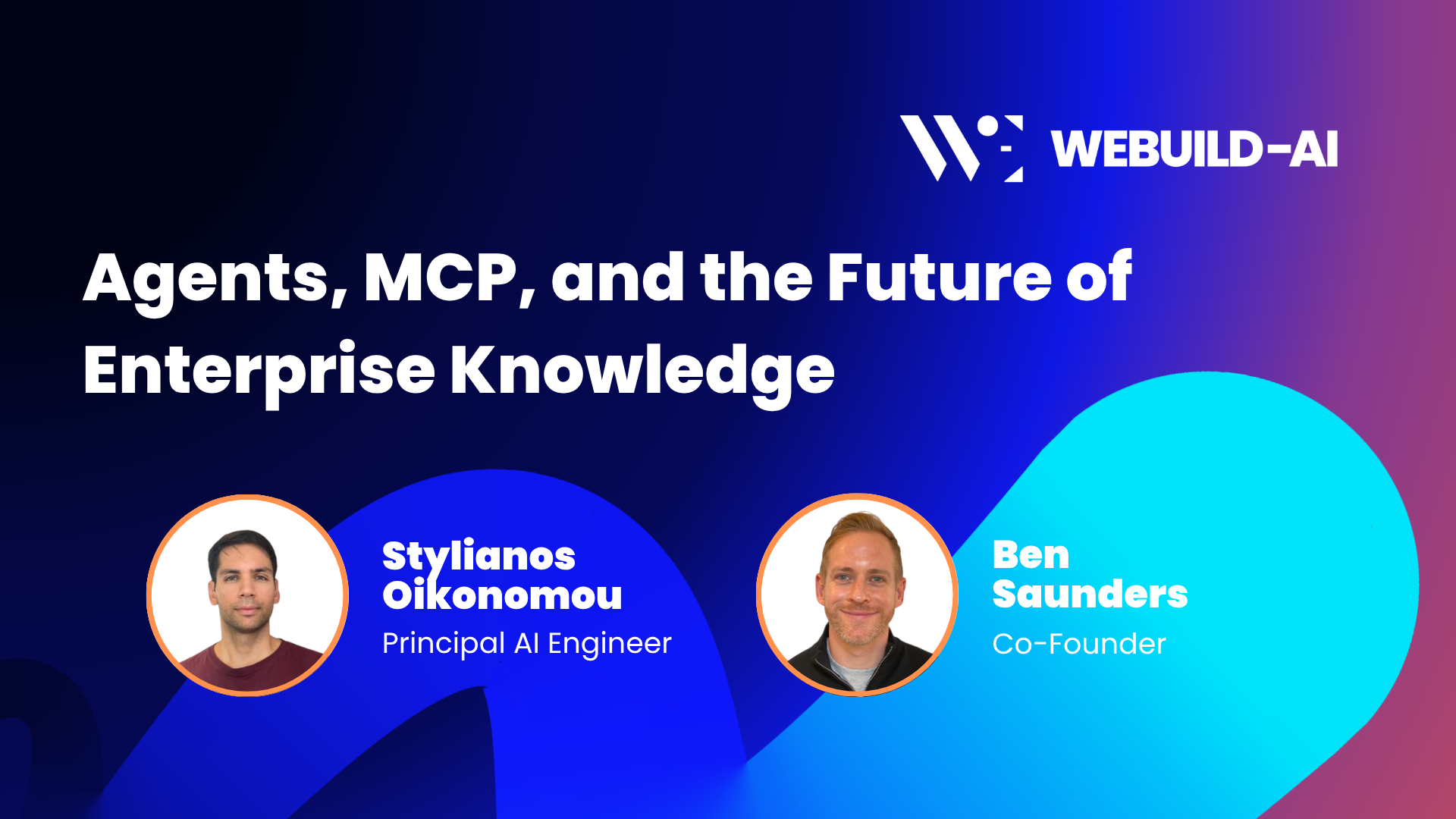
Watch our webinar recording, where we demonstrate how Model Context Protocol (MCP) and AI agents convert conversational AI into business tools.

Discussing what organisations must do to join the small group that succeeds in AI adoption - only 5%, according to MIT research from 2025.

We examine the relationship between Model Context Protocol (MCP) and Retrieval-Augmented Generation (RAG), asking if MCP’s capabilities will remove the role or shift the relevance of RAG in enterprise systems.

Practical learnings from real enterprise deployments of MCP: architecture decisions, challenges, tradeoffs and guidelines for adoption at scale.

Covering the data governance, security and privacy challenges that arise when connecting AI agents to enterprise data via Model Context Protocol (MCP), as well as how to mitigate risks.

How MCP enables AI systems to make insights more actionable, integrated and contextually aware, based on relevant enterprise data.

Model Context Protocol (MCP) lets AI systems securely interface with enterprise data, breaking silos and embedding context into AI outputs. Read on to find out more.

The Enterprise AI Governance Playbook: Building Sustainable Oversight in a Rapidly Evolving Landscape

The foundational principles WeBuild‑AI used for building our Pathway platform, from AI‑native design to guardrails, ethics and automation as code.

Learn how enterprises can build GenAI capabilities into daily workflows through continuous practice, experimentation and organisational learning.

Explore the architecture, tools and processes needed to scale generative AI across enterprise environments efficiently and securely.