Data and AI Governance Across 10 Domains: A Technical Framework for UK and European Enterprises

Data and AI Governance Across 10 Domains: A Technical Framework for UK and European Enterprises
Download WeBuild-AI's technical whitepaper covering the 10 governance domains every enterprise must address before deploying AI, aligned to the EU AI Act and UK regulatory landscape.
Enterprise AI adoption is outpacing the controls that govern it. 97% of organisations that experienced AI-related breaches lacked proper AI access controls, yet only one in five has a mature governance model for the autonomous AI agents that 74% are planning to deploy within two years. The regulatory window is closing: the EU AI Act's high-risk obligations apply from 2 August 2026, and the UK's Data (Use and Access) Act 2025 has already commenced.
This whitepaper provides a structured, technically grounded breakdown of the 10 governance domains that form a practical framework for enterprise AI deployment. It is written for the teams responsible for building it right - technical architects, data leads, compliance and legal - as much as for the executives accountable for it.
What's inside
Drawing on the RAG (retrieval-augmented generation) architecture as its primary reference model - the most common enterprise deployment pattern - this whitepaper gives you implementation-level guidance across all 10 domains, with explicit notes on where fine-tuned models, agentic systems and multi-model pipelines diverge.
Each domain covers the regulatory context, what we see go wrong in practice, and concrete implementation requirements you can act on.
The 10 domains:
Data Protection & Privacy
Data Sovereignty & Residency
Regulatory Compliance
AI-Specific Governance
Security
Content Safety & Guardrails
Audit & Accountability
Operational Governance
Intellectual Property
User Trust & Transparency

So it finally happened, I was pulled into a meeting and told to replace myself with AI.” Read Elena’s full breakdown on how to use the Ralph Wiggum Loop to speed up development, including learnings and a step-by-step guide.
A comprehensive guide to what the software development lifecycle looks like now that AI agents are part of the team, and how to implement it at enterprise scale.

Your team can feel the time an AI tool saves, while your board needs to see where that time actually went. Here’s what to measure, and what an invoice pipeline taught me about the difference.
Why we paired Neo4j, knowledge graphs and the Model Context Protocol inside our AI Accelerator, and how the combination turns months of integration work into days.
WeBuild-AI announces its new partnership with OpenAI. WeBuild-AI will continue working with OpenAI to help organisations build, deploy, and scale AI solutions responsibly and effectively at a global scale.
Every electricity network operator is working with AI; fewer can say where AI projects actually stand, what's stalling progress internally, or how they compare with peers working under the same regulatory constraints. This report answers that using data from operators across the UK electricity system, not vendor commentary or generic industry predictions.
Taking inspiration from The Phoenix Project, we tell the story of Marchmont Group, a fictional enterprise with a hundred and forty-two AI use cases and nothing in production, and introduce Deliberate AI, the methodology we built to close the enterprise AI success gap.
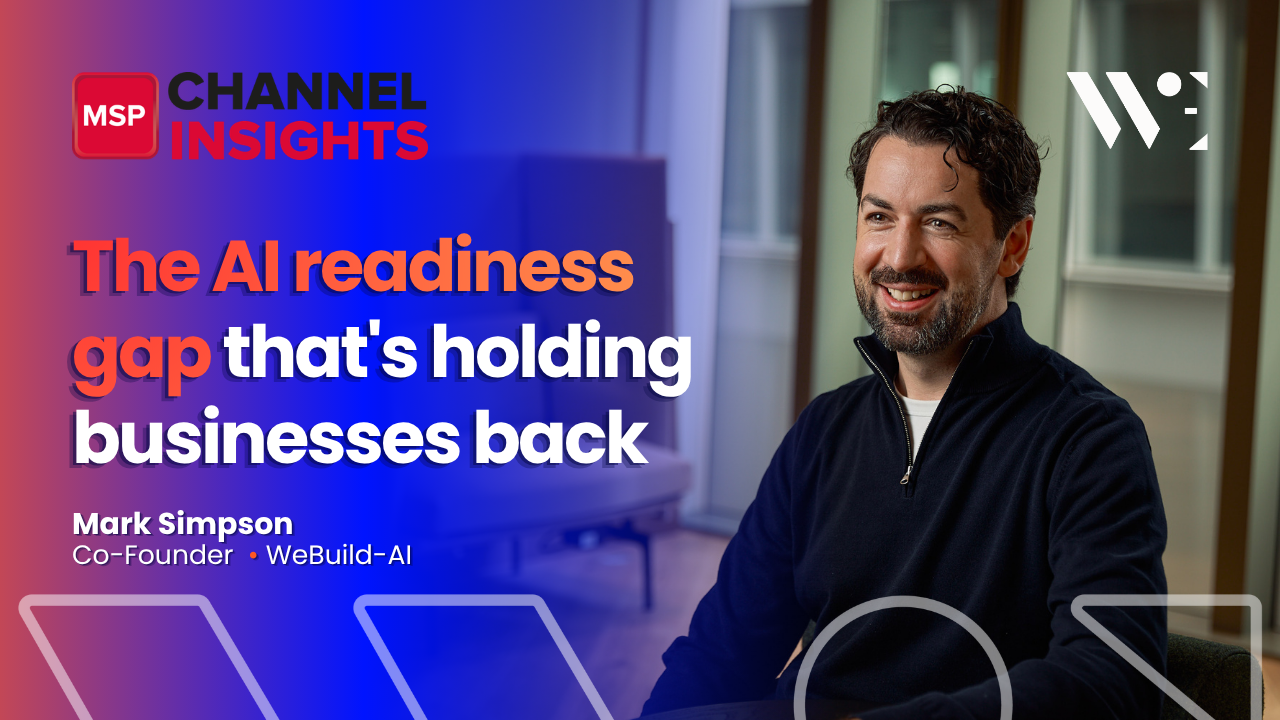
Mark Simpson, Co-Founder of WeBuild-AI, writes for MSP Channel Insights on why firms adopt AI faster than they can operationalise it, and why governance, data foundations, and change management matter more than training alone.
Mark Simpson, Co-Founder of WeBuild-AI, writes for Digitalisation World on why firms invest in AI before governance, data foundations, and operating models are in place, and why upskilling alone does not close the readiness gap.

Principal Consultant, Josh, walks us through how the WeBuild-AI team built and shipped a scalable AI platform in 4 months that generates regulator-ready documents in under 90 minutes.
Mark Simpson, Co-Founder of WeBuild-AI, writes for TechRadar Pro on why UK businesses stall in the sandbox, and what operational alignment, data foundations, and governance require before AI moves from pilot to production.
In this post we explore why open source models have crossed the threshold for everyday enterprise use, why Anthropic's decision to open source its Agent Skills framework is a bigger deal than it might first appear, and why the organisations best placed to move quickly with AI are those thinking carefully about where their data lives and which model is appropriate for which task.
Ben Saunders, Co-Founder of WeBuild-AI, writes for Financial IT on why banks run plenty of AI pilots but struggle to move them into production, and what governance, observability, and operating-model clarity require before scaling in regulated environments.
Head of Platform Engineering Dan shares the detail on his role at WeBuild-AI, his career history and development, including an impressive number of languages and achievements.
Mark Simpson, Co-Founder of WeBuild-AI, writes for NODE Magazine on why UK enterprises stall in pilot purgatory, and what operational alignment, data foundations, and governance require before AI reaches production.
For as long as retailers have sold online, the visitor on the other side of the screen has been a person. Someone to be attracted, reassured, nudged and, with luck, converted.
In an earlier companion piece we shared that agentic commerce has arrived, that buyers and their agents are increasingly beginning their journeys inside AI assistants, and that the answer an assistant returns is becoming the new shelf.
For the better part of three decades, the governing metaphor of digital commerce has been the shopfront. A business builds a website, draws visitors to it through search and advertising, and does what it can to convert their attention into a purchase once they arrive.
At an executive partner dinner a little while ago, the conversation drifted, as these conversations invariably now do, towards the question of what everyone is really spending on artificial intelligence. One of the firms around the table offered a figure that gave the rest of us pause.

Download WeBuild-AI's whitepaper on AI agents in the energy and electricity sector - types of AI agents, where they are applicable across the grid, how they work, what’s available now and what’s coming soon.
In January 2026, Ofgem published its consultation on a proposed AI Technical Sandbox - a structured, regulatory-led environment where energy sector participants can test and trial AI solutions under oversight. We responded in March 2026.
Ask most boards what AI sovereignty means and you will get one of two answers. Either it is a UK region on a hyperscaler, or it is a box in a private data centre. Both answers share the same flaw: they treat sovereignty as a place. Pick the right location, the thinking goes, and the problem is solved.
When Anthropic withdrew Claude Fable 5 globally just three days after launch, following a US export control order, it proved that enterprise AI concentration risk is no longer just commercial but geopolitical. This article makes the case for a resilient multi-model strategy spread across providers and jurisdictions for enterprise AI.

Discover three core AI use cases for private equity and venture capital firms and what it took to build them - automated competitor analysis, company research and LPA knowledge retrieval.

How to move your AI Agents from POC to production: a step-by-step guide, no matter your department or industry.
MIT research shows that 95% of organisations see zero return on their AI investment and AI is about to stress-test every weakness in your data foundation. Read on for how to build an AI-ready data foundation.
Discover how the WeBuild-AI team moved from Figma to functioning frontend in four weeks, including the full scope of multi-functioning tools, user testing and key learnings.

The question isn’t whether you need an AI Centre of Excellence. The question is how to build one that enables rather than obstructs, that governs without strangling innovation, whilst creating genuine enterprise value.
How to build an AI operating model that actually delivers: focus investment on two or three high-value workflows, centralise orchestration, establish governance before scaling, design for human-AI collaboration, and plan the talent bridge between internal teams and external partners.

Discover which three AI workflows can have the most transformational value for PE due diligence teams, based on our industry experience with real customers and in-house AI expertise.
 Linda Joseph
With over a decade of technical experience, Linda's hands-on expertise in Data and AI spans both consultancy and in-house roles. Since completing her Masters in Data Science and Analytics, she has contributed to a range of AI and advanced analytics initiatives across industries, helping organisations apply data-driven and AI-enabled solutions to solve complex business problems. Within WeBuild-AI, Linda is known as the "Governance Queen" for delivering robust governance strategies and frameworks that allow organisations to adopt AI responsibly in complex, global and highly regulated industries.