
AI Operating
Model Design
Balance your team’s capacity and expertise with smart operating models, adjusted to maximise output based on your needs.
We build AI strategies aligned to your goals, through production-grade AI solutions, enterprise-ready compliance frameworks, custom tooling and our highly skilled team.

Our Services
Optimise your team’s function and outputs through operating models designed around you. Operating model design allows you to flex to capacity, bring in niche, expert talent and deliver production-ready solutions.
We use operating model design to ensure our customers are getting the most effective results possible, all within project scope.
We offer:
-
Balancing expertise, budget and timeframes to optimise outputs on project delivery. Operating model design is an essential part of every project we deliver to production.

Our Customers
Our Approach
Working across multiple industries, we build AI operating models that align to your current and future talent and expertise, flex to capacity needs and ensure your AI projects are delivered to production on-time and on-budget.
Because getting AI right means building the best possible frameworks to deliver solutions.
Our Latest Insights
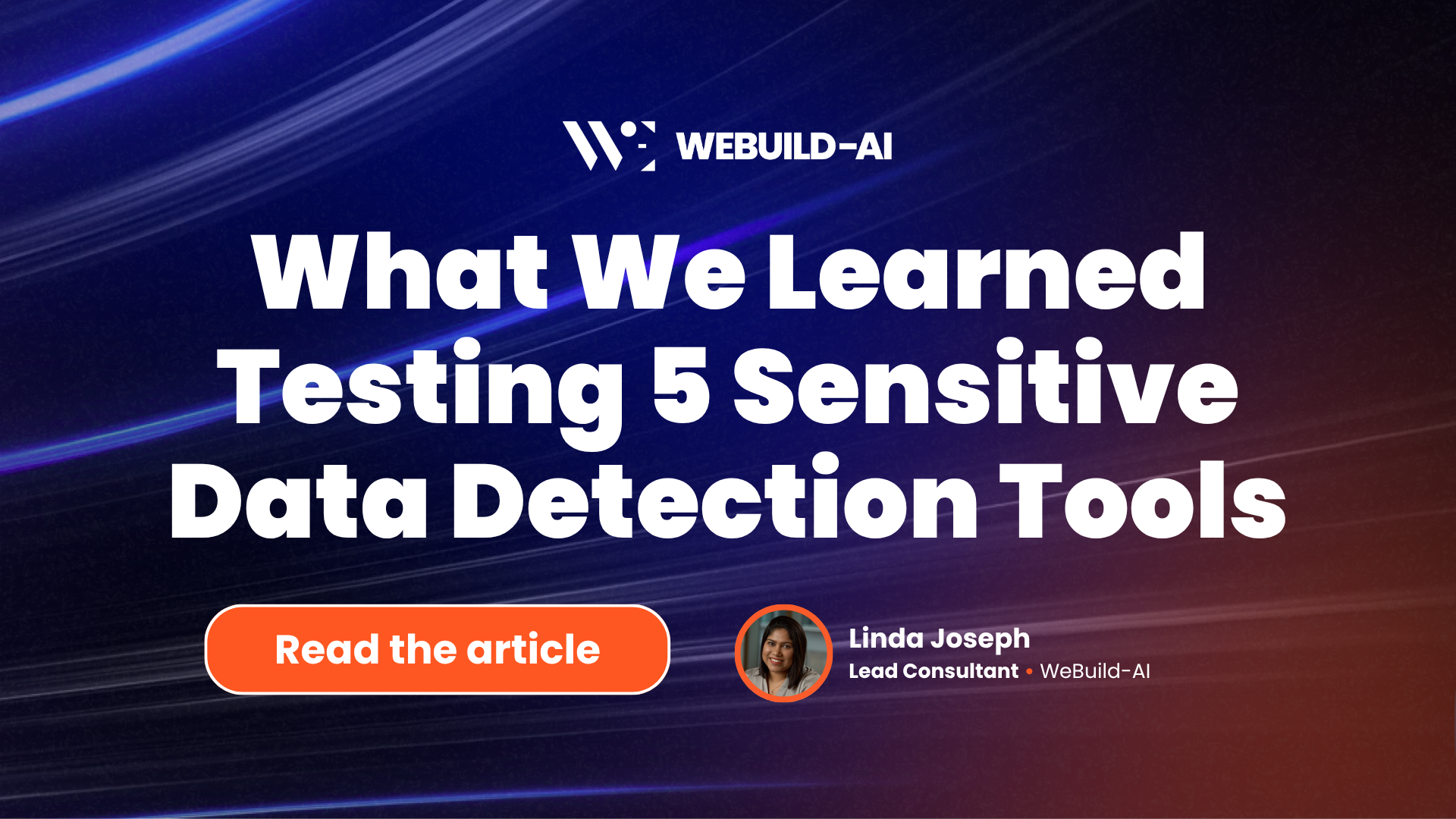
We tested sensitive data detection tools Amazon Macie, Microsoft Purview and three open source tools on 18,049 documents to see how much sensitive data automated data classification really finds. Read for our recommendations and what a layered approach costs to run.
At an executive partner dinner a little while ago, the conversation drifted, as these conversations invariably now do, towards the question of what everyone is really spending on artificial intelligence. One of the firms around the table offered a figure that gave the rest of us pause.
Ask most boards what AI sovereignty means and you will get one of two answers. Either it is a UK region on a hyperscaler, or it is a box in a private data centre. Both answers share the same flaw: they treat sovereignty as a place. Pick the right location, the thinking goes, and the problem is solved.

Most enterprises are deploying AI faster than they can govern it and regulators are taking notice. This article introduces 10 governance domains that form a practical framework for enterprise AI deployment, covering data protection, sovereignty, regulatory compliance, security, content safety and more, backed by peer-reviewed data and with additional guidance aligned to the EU AI Act and UK regulatory landscape.

Download WeBuild-AI's technical whitepaper covering the 10 governance domains every enterprise must address before deploying AI, aligned to the EU AI Act and UK regulatory landscape.

Build collaborative and flexible AI governance frameworks that enable rapid innovation, production and delivery, and ensure your AI plans are on-time, on-budget and compliant in 2026.
![Accelerate AI deployment while maintaining compliance through 2026 [Webinar]](https://images.squarespace-cdn.com/content/v1/67ffe031b1ec5e458d56ffe2/1764069307195-S4RKZ5B8G8VQ3NXNND1K/balancing-governance-with-innovation-in-ai-a-strategic-framework-for-scaling-ai-in-regulated-industries.jpg)
Enterprise manufacturing business DS Smith and AWS share their secrets to AI governance, innovation and compliance success, through AWS Bedrock foundation and AI Transformation Consulting from WeBuild-AI.

Evaluate your organisation's AI governance readiness across UK, EU, and US jurisdictions.

Moving from AI theory into AI operations leaves many leaders behind from a regulation and compliance perspective. Here’s what you need to know for 2026.

Comprehensive overview of the “what” and the “how” for approaching industry-specific legislation in 2026.

The Enterprise AI Governance Playbook: Building Sustainable Oversight in a Rapidly Evolving Landscape

Actionable techniques to ensure secure LLM deployments that balance innovation with function, from using prompt injection protection to ethical use and access controls.

Explore how structured model lifecycle management turns governance principles into an operational reality, helping to guide AI development from design through retirement with control, transparency and trust.

Our day 2 of the Paris AI Summit tackled the intersection of policy, ethics, and innovation and highlighted the collaboration between leaders and tech.

Our day 1 recap of the Paris AI Action Summit shares global insights on responsible AI, innovation policy and enterprise transformation.

Successful AI depends not just on tech, but on humans - particularly responsible development, deployment and use.

A C‑level framework to adopting AI responsibly, balancing innovation with risk, oversight and scalability to achieve fast and ethically scale solutions.

Why and how enterprises need to build and maintain an Acceptable Use policy, which should create guardrails, rules and oversight for how generative models are used internally.

Learn about the WeBuild-AI mission to help enterprises build faster and more effective teams and processes with generative AI.

Discover practical steps to building effective AI governance, including balancing innovation with risk, compliance and accountability.

Explore how MLOps can ensure AI ethics and transparency in your organisation in "AI Ethics & MLOps - Go Fast, Without Breaking Transparency." This blog by Ben Saunders delves into the importance of integrating ethical considerations and governance into the machine learning lifecycle. Learn how MLOps frameworks can help build, deploy, and manage AI models that are reliable, transparent, and compliant with legal standards, fostering trust among customers and regulators while accelerating AI adoption.

In this blog, Ben Saunders explores the IP dilemma in the age of AI, focusing on the tension between content creators and AI companies over the use of intellectual property in training AI models. It discusses the challenges of balancing innovation with creators' rights, proposed solutions like digital watermarks and licensing, and the potential of data ownership and consent management as a path forward for fair compensation and ethical AI development.

The evolving AI risks landscape is rapidly changing, presenting new challenges and opportunities for businesses and individuals. This blog explores the latest AI threats, including deepfakes, data privacy breaches, and algorithmic biases. Learn how to mitigate these risks with strategic planning, robust cybersecurity measures, and ethical AI practices to stay ahead in this dynamic environment. Stay informed to safeguard your future in the AI-driven world.

Navigating the Risk Landscape of AI Systems: A Short Guide provides crucial insights into the complexities of managing AI-related risks. As AI technologies become increasingly integrated into various sectors, understanding potential threats such as data privacy concerns, algorithmic biases, and security vulnerabilities is essential. This guide offers practical strategies for identifying, assessing, and mitigating these risks to ensure safe and ethical AI implementation. Whether you're a business leader, IT professional, or AI enthusiast, this short guide equips you with the knowledge to navigate the evolving AI risk landscape effectively.