
The worst time to decide how an AI agent will be measured is after it has been built. By then the architecture is already producing the signals it happens to expose, the team has seen enough outputs to form an opinion about what “good” looks like, and it becomes tempting to choose measures that explain the system rather than measures that test whether the system is genuinely useful.
An evaluation-first approach reverses that order. Before choosing the model, the agent framework or the number of agents in a workflow, the team defines the task, the acceptable outcome, the failure conditions and the evidence that will be needed to trust the result. The performance metrics therefore begin in Shape, alongside the specification, rather than appearing as a dashboard once the capability is already in Assemble or Run.
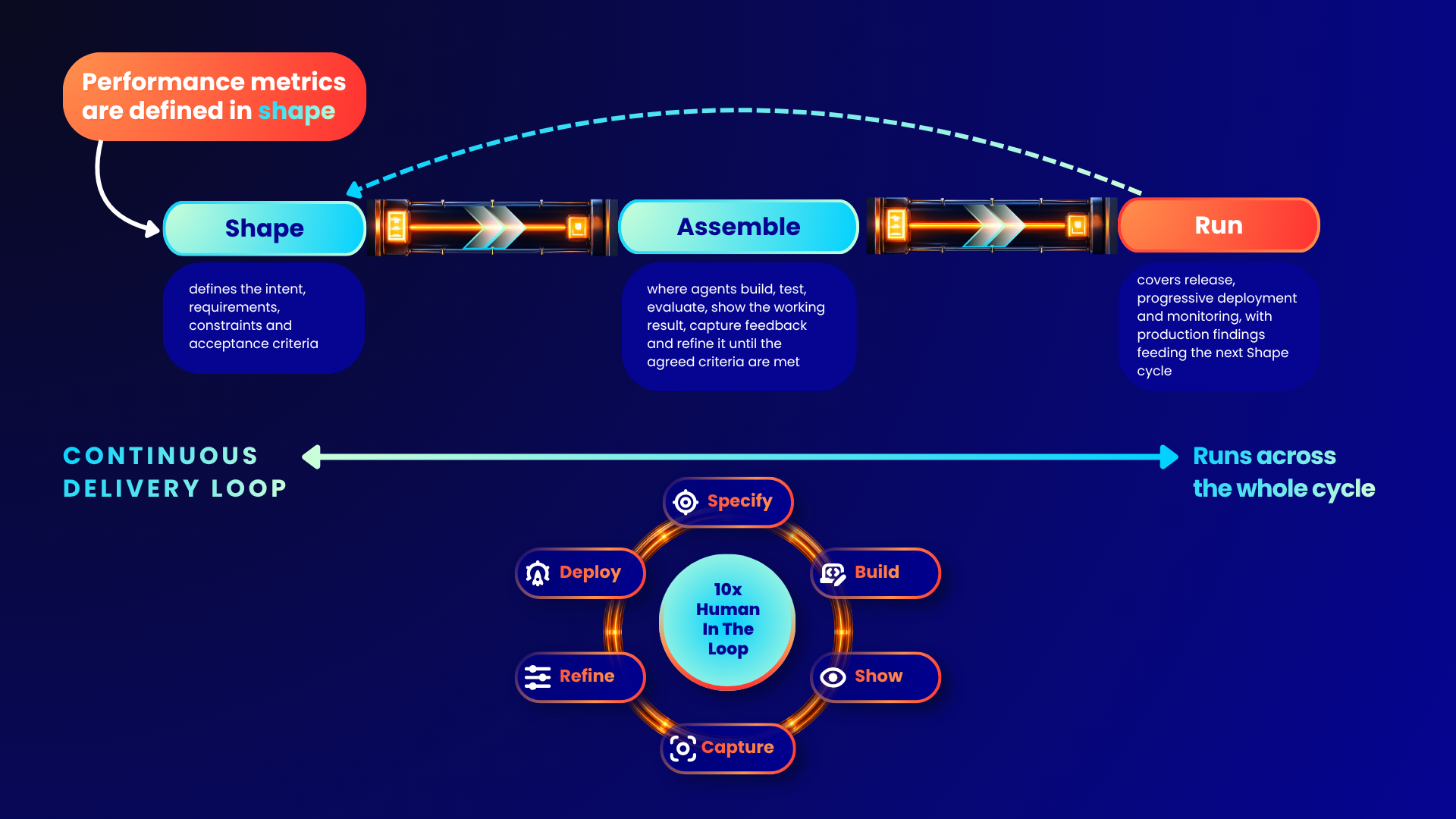
This changes how the system itself is designed. If an organisation wants to understand why an agent succeeded, why it failed, what it cost and whether a more complex orchestration was necessary, the system has to preserve that evidence as it runs. Evaluation is therefore not an activity bolted onto an agent. It is one of the design constraints of the agent platform.
Start with the job, not the model
The first performance question should be “what outcome are we trying to improve, compared with what happens today?”, and the existing process provides the baseline. That may be analyst time, turnaround time, defect rate, exception rate, human review effort or another business measure that already has meaning.
The specification should then convert that baseline into explicit acceptance criteria. Some outcomes may be tradeable, such as a small increase in latency for materially higher quality. Others may not be tradeable at all. A system that generates a document faster but introduces an incorrect financial figure has not improved the process. This is why the business, engineering and assurance functions need to agree the measures together. Engineering can instrument latency and token usage, but it cannot decide alone what level of factual error, manual intervention or operational risk is acceptable. Those limits belong in the specification before the first agent is built.
Treat the task as the unit of evaluation
A useful way to keep evaluation independent of a particular agent framework is to separate four ideas: the task, the target, the trajectory and the evaluation result.
| Concept | What it means |
|---|---|
| Task | The work to be done, including inputs, expected outcome, acceptance criteria and relevant constraints. |
| Target | The executable system being tested. It may be one model call, one agent, a deterministic workflow or a multi-agent team. |
| Trajectory | The record of what happened during execution: outputs, tool use, model calls, retries, hand-offs, latency, cost and failures. |
| Evaluation | The checks and judgements applied to the outcome and, where relevant, to the trajectory that produced it. |
This lets the organisation compare different implementations against the same work, so a direct model call, a tool-using agent and a dynamic team can all be evaluated on the same task.
Measure the outcome and the route taken
For deterministic software, a passing output can often tell us most of what we need to know. Agents are different because two executions can reach a similar final answer through very different routes. One may retrieve the correct source immediately, while another may call the wrong tool several times, recover by chance and still produce an acceptable answer. If only the final text is scored, those two executions look equivalent when operationally they are not.
Agent performance therefore needs at least two views.
The first is outcome quality: correctness, completeness, groundedness, adherence to the specification and whether the business task was actually completed.
The second is execution quality: latency, cost, tool calls, retries, hand-offs, human interventions, failure recovery and whether the agent stayed within the permissions and context intended for the task.
The second view becomes especially important as systems become more agentic. A multi-agent workflow can improve a difficult task while also multiplying model calls, increasing latency and creating more places for state or routing to fail. Those costs are the evidence needed to decide when the additional orchestration has earned its place.
Use deterministic evidence before asking another model
Not every agent output needs an LLM judge. Where a requirement can be checked directly, deterministic evidence is usually stronger. For example:
Required sections in a report can be checked from the document structure.
Calculations can be compared with known values.
JSON can be validated against a schema.
Tool permissions, retry limits and required citations can be checked from the execution record.
Model-based evaluation is valuable where judgement is genuinely semantic: whether a summary captures the important evidence, whether an explanation is useful to its intended audience or whether a response is sufficiently complete when several phrasings could all be correct. Even then, the judge needs a task-specific rubric rather than a generic request to “score the answer” and the evaluation should state what good means for that task and preserve the judge rationale alongside the score.
The principle is simple: use the most objective evidence available first, and use model judgement for the part that cannot be reduced to a deterministic check. That reduces noise, makes failures easier to investigate and gives assurance teams evidence they can inspect without having to trust another opaque score.
Design the architecture so evaluation is possible
Evaluation-first engineering affects the architecture because the system needs a stable execution boundary. A workflow should be able to run a deterministic Python step, a direct LLM call, an agent or a team without the evaluation layer being rewritten for each implementation. Each execution should return a standard result and emit enough structured events to reconstruct what happened.
The workflow layer should own the task and the execution contract, while framework-specific behaviour sits behind adapters. An AutoGen agent, for example, may still use its own runtime and message passing internally; the surrounding platform can translate that execution into the same result and trajectory used by a plain function or another framework. This keeps evaluation attached to the organisation’s workflow rather than to a vendor library.
The practical benefit is that evaluation can happen at different levels. A team can evaluate one section-generation step using fixed evidence without rerunning an expensive end-to-end workflow. It can separately evaluate retrieval, calculation or review. It can then run a smaller number of end-to-end cases to test how the parts interact. Component evaluation tells the team where a failure occurred; end-to-end evaluation tells the organisation whether the capability as a whole is acceptable.
Make complexity earn its place
Agent architecture is often discussed as though more autonomy is an upgrade. Evaluation gives the team a better question: what is the simplest system that meets the requirement? The useful comparison is a progression of baselines against the same task set.
A direct model call may be enough for a bounded transformation. A tool-using agent may be justified when the task requires retrieval or actions. A deterministic sequence of agents may help where the stages are known in advance. A dynamic team may be valuable when the system genuinely has to decide what work should happen next. Each step to the right adds capability, but also additional latency, cost and failure surface.
The metrics should make that trade-off visible. If a multi-agent design produces the same quality as a single agent at several times the cost and latency, the organisation has learned something useful before that complexity reaches production. If the multi-agent design materially improves difficult planning or verification tasks, the evidence shows where that complexity is worth paying for. The objective is not to maximise agent sophistication, but to choose the smallest architecture that consistently meets the specification.
Build the evaluation set from real work
The quality of an evaluation suite depends on the quality of the tasks inside it. The suite should contain representative work, important edge cases, known failure modes and examples where superficially similar requests require different outcomes. This is especially important when prompts, tools or agent instructions are being optimised, because an evaluation set that is too narrow can be improved without the underlying capability becoming better.
Evaluation data should therefore be versioned alongside the other delivery artefacts. A change to a prompt, model, tool contract, context source or workflow should be testable against the same known tasks, with the configuration that produced each result recorded. The team should be able to move from an aggregate score back to the exact task, execution trajectory and evidence that produced it.
That traceability also prevents a subtle failure mode in evaluation itself. A missing judge result, a crashed task or an unavailable metric should be recorded as an evaluation failure, not converted into an average score. “Could not measure” and “performed adequately” are different states, and an enterprise control should preserve that distinction.
Production closes the loop
No pre-production suite will contain every situation an agent eventually encounters. Production therefore becomes another source of evaluation knowledge. Traces show what happened in an individual workflow, monitoring shows whether quality, cost or failure patterns are changing, and incidents reveal cases the development team did not anticipate.
Those findings should feed back into the evaluation set. A production failure becomes a regression case. A new policy or source of context triggers the relevant evaluations again. A recurring manual intervention may show that the agent is not as autonomous as the original metric suggested. In this way the evaluation suite becomes part of the delivery record and grows with the system rather than becoming a one-off gate before release.
Performance metrics are part of the design
The practical lesson is that agent metrics begin with the baseline and the specification, shape the execution contract, determine what the platform must record and continue through production. That is what makes evaluation a control rather than a report.
Teams that design for evaluation from the start can answer the questions that matter later:
Did the capability improve the process?
Which tasks does it handle reliably?
What does additional orchestration buy us?
Why did this execution fail?
What changed between versions?
What evidence supports the decision to deploy?
Those questions are much harder to answer if the system only preserves the final response. An evaluation-first architecture makes the evidence part of the system itself. The result is an agent capability that can be improved, governed and owned with the same engineering discipline as the software around it.