Every decision needs the right home at the right time
AI-assisted software development enables teams to produce code worthy of an enterprise change in just a couple days, yet the decisions needed to set the development direction, approve the developed features afterwards and enable the mandate for adoption lags significantly behind.
To accommodate working code sitting and waiting for approvals, we changed tact - the team retired the sprint board and replaced it with a specification tracker. This helped set direction but the true gear shift needed lay post development. Once building stopped being the slow part, every change found somewhere else to wait. But, in almost every case the decision being waited on had no owner close enough to the work to make it on the mandate to drive the adoption.
Our view, having watched this pattern repeat across engagements, is that agents have not so much created a governance problem in enterprise delivery as exposed one that was already there. The teams moving fastest are those where every decision has a home, and where the people who understand a service are trusted to accept routine change to it.
AI-native development will always fall short of potential if it lacks supporting authority
Developing with AI-assisted practices means that you can now accept an ambitious scope, you can prove the feature, you can create robust end-to-end testing and you can have a fully-fledged CI/CD pipeline supporting this in record time. Yet we’ve seen organisations have the relevant mandate and skills sat in different business units, regions and teams, which makes the overall time to get that authority time-consuming and challenging and typically requiring a committee decision or central board.
It’s clear that more engineers would not fix any of that, the constraint is the decision maker. Our recommendation is that the business appoint a senior leader to own its data and AI platform,and in turn start building its own engineering team, working with us on governance forums and an accountability model sized for the appropriate delivery pace rather than the pace it used to run at.
A similar vein is applied to development autonomy, where it’s possible to build in days, yet wait on tickets for weeks or months
Any model of detached, slow decision-making and the requirement to raise hundreds tickets to enable a solution, drastically hampers the potency of AI-native development.
Any platform sat inside a group-wide estate where the team can’t create its own repositories, add developers to the artefact registry, manage its own identity groups or grant itself access to the cloud resources it had just provisioned, becomes a service request to a central team working through its own backlog.
When aiming to deliver a flagship capability in 3 months, the challenge only increases when adding up to more than 100 business days of cumulative waiting.
Very few tickets involve a decision that carries real risk; they are sensible controls applied one request at a time and together they turned a delivery team that could build in days into one that spent a meaningful share of every sprint waiting, sometimes 2 sprints.
This lessens the overall time for testing, for sharing with users, to help them feel confident and comfortable in using the solution, as the team are instead focused on finding names to chase tickets and escalate to meet a deadline.
The case we put to leadership proposed time-limited elevated access granted on demand within an agreed scope, project-level administration of the toolchain for a named lead, delegated management of the team's own identity groups, and onboarding bundled into a single request.
Applying a risk management lens on decisions can create two routes
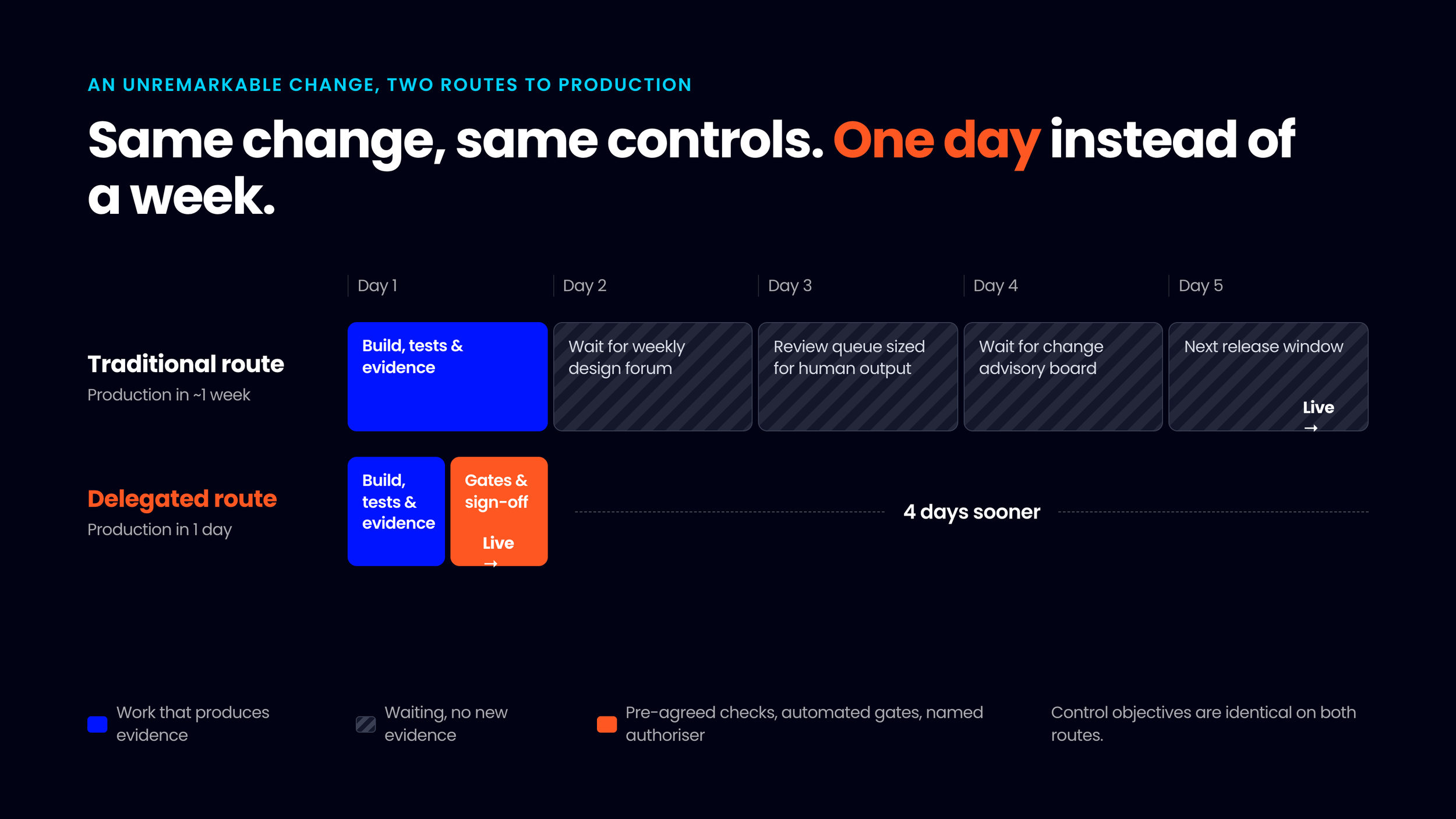
Take for example an ‘unremarkable change’, such as adding a new element to an existing screen such as a new filter. AI-native development could mean that the code, the tests and the evaluation evidence can be ready within a day.
Via the traditional route, that finished change then could wait for the weekly design forum, then joins a review queue that was sized for human output, then waits again to be presented at the change advisory board before it can go into the next release window. Time: 2 day build, 2-3 weeks approval.
Via the new delegated route, the same change is checked against conditions agreed in advance. If those hold, the team that owns the service accepts it, the automated gates run and a named person authorises the release at the production gate. Time: 1 day build and approval.
The only real difference is whether the decision is made by people who understand the service at the moment the evidence is ready.
Every decision at the right level
Our recommendation on ownership means every decision has an owner and cadence that fits its consequences. Strategic direction is set quarterly by a steering committee, the portfolio is reviewed monthly with the value office, the product owner runs planning and demonstrations every fortnight, and the delivery team makes its implementation calls every day.

A framework for delegated decisions
The operating model in our ebook comes down to three ideas, and each of them is aimed at maintaining the quality / quantity trade-off which naturally comes with this territory.
1. Delegated conditions are agreed before the work starts, so the product owner with the delivery team can accept a familiar class of change when the affected components are known, the evidence is complete and no protected control or external commitment moves.
2. Escalation is written down, so anything that crosses a shared service boundary goes to a named specialist or risk authority for independent challenge.
3. Teams or individuals should be named and allocated ahead of the start of the project with alignment to the project success.
Once routing works like this, familiar work and genuine exceptions stop queuing behind each other. Routine change moves at the pace of the team that knows the service, and specialists spend their time on the decisions where their judgement actually changes the outcome.
Delegation also keeps challenges from domain experts in the room, ensuring all work is quality checked. Via a central function, decisions with differing opinions from multiple teams can be finalised and then built into future builds to prevent the same discussions happening again and again. This path mirrors the approach of moving from agile software development to AI-native software development life cycles.
A test you can run this week
Where did the change wait longest once the work was finished?
Who could have made that decision, and how close were they to the service?
Did the wait produce any evidence that did not already exist when the change was ready?
Was the control objective met by the meeting itself, or by checks that could have run automatically?
If the same approval keeps turning up as the longest wait, another agent or a bigger review team is unlikely to help. That pattern is telling you to look again at the decision itself, at who owns it and at whether the way it is made still fits the risk it was meant to control.
Agents will keep taking on more of the implementation, which makes it all the more important to be clear about who holds the intent and who answers for the result. Our bet is that the organisations giving that authority to the people closest to the work, inside limits the platform actually enforces, will be the ones whose faster building finally shows up as faster delivery.